The people who carry customer context — across the tools that scatter it.
Every role below already holds part of the picture. The problem isn’t that the evidence is missing — it’s that it lives in different tools, owned by different teams, and nobody ever connects it. Here’s what changes for each of them when it’s unified.
You own the number. You're reading it weeks too late.
Renewals, net revenue retention, the board deck — all of it lands on you. But the signals that decide those numbers are scattered across your team’s inboxes, calls, and tickets, and they reach you long after the moment they mattered.
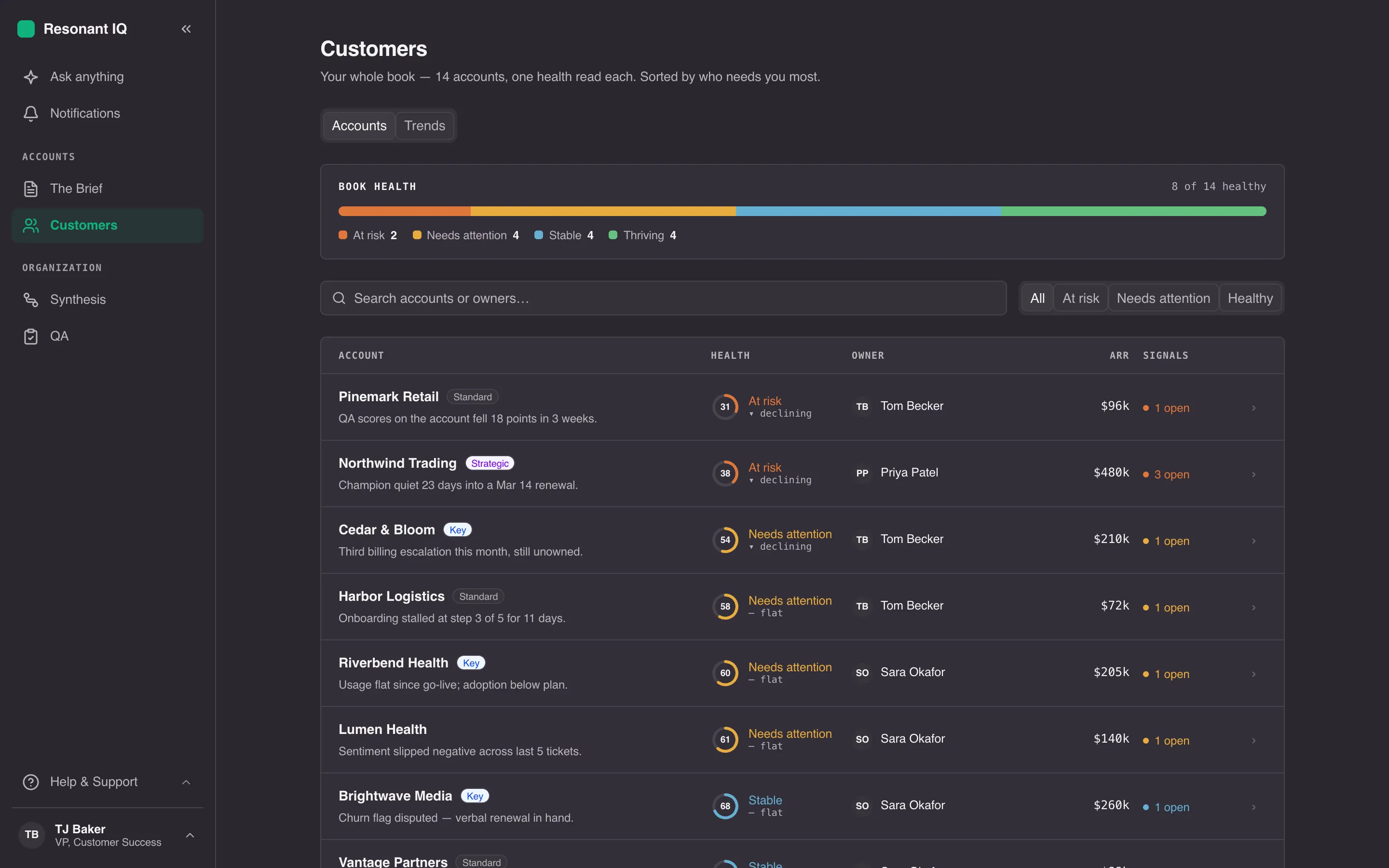
See which accounts are actually at risk before the QBR.
The account that went quiet across three channels surfaces on its own — with the conversations that made it quiet attached.
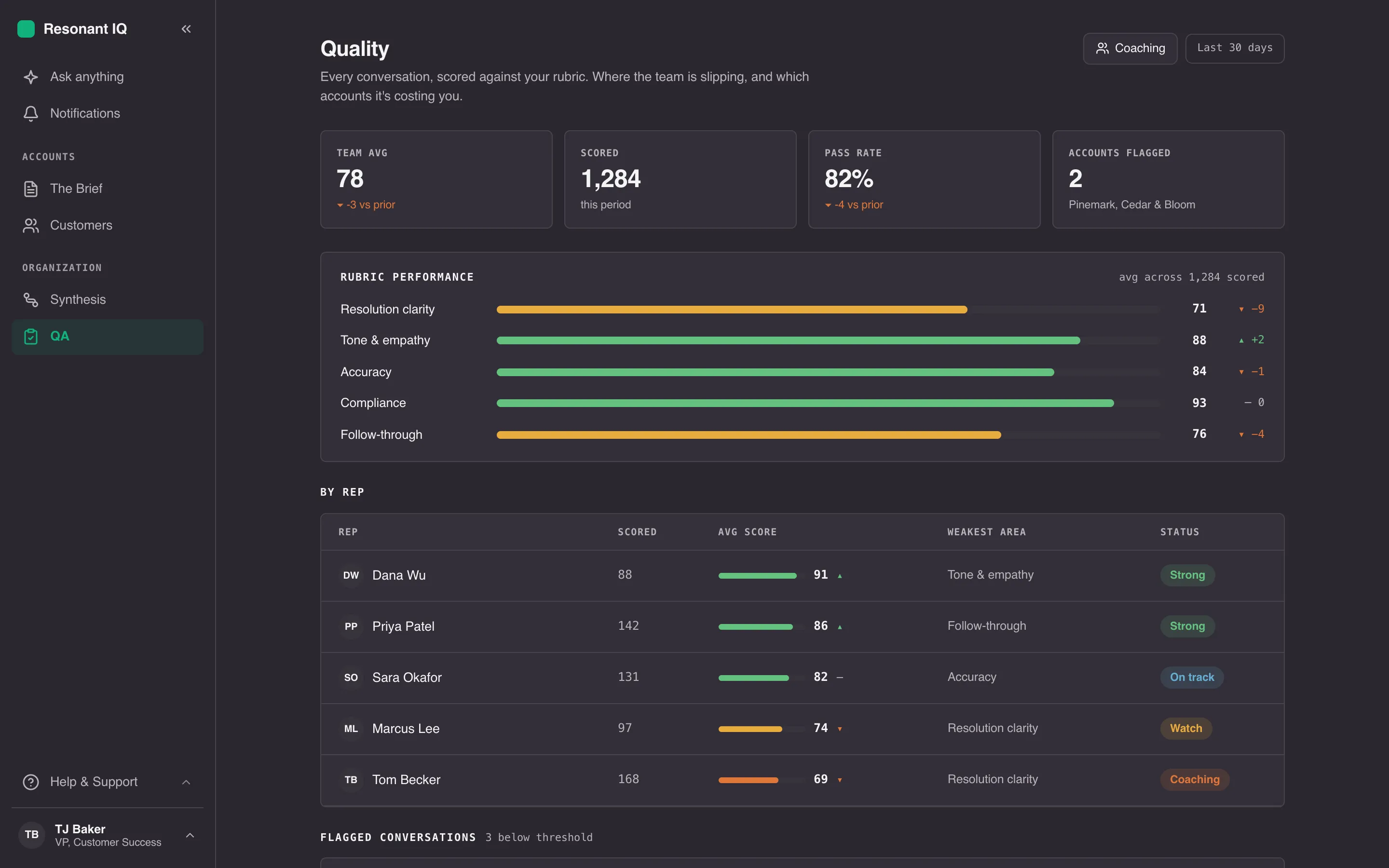
Know your team is catching what matters.
Every conversation is read against the scorecard you set, so a missed signal is a gap you can see — not one you find out about at renewal.
Walk into the board meeting with evidence, not anecdotes.
“Customers keep asking for this” becomes “eleven accounts this quarter,” with the source conversations one click away.
The loud ticket gets the war room. The quiet account gets nothing.
Your team triages by volume, because volume is what the queue shows. The account that stopped replying never files a ticket — so it never reaches the queue, and never reaches you.
Find the risk sitting inside resolved tickets.
A frustrated thread that closed “resolved” still surfaces as a signal, tied back to the exact reply that left the customer cold.
Coach from what actually happened, not a sample.
Every conversation is scored as it comes in, with coaching notes drafted beside the score — not pulled from the handful you had time to read.
Show the rest of the company what support already knows.
The themes your agents hear every day get counted and routed to product and CS — instead of dying in a closed ticket.
You carry forty accounts and remember the three that emailed this week.
The rest live in your head, in scattered notes, and in threads you meant to circle back to. The account drifting toward churn rarely announces it — it just goes quiet across the channels you don’t have open.
Walk into every call already knowing where the account stands.
One timeline pulls together every touchpoint — support, email, calls — so you read the account in a minute instead of reconstructing it from five tabs.
Catch the silence before it becomes a surprise.
The account that stopped replying, stopped raising tickets, and stopped showing up to calls surfaces while there’s still time to act on it.
Spend your hours on the accounts, not the busywork.
The status-gathering that ate your mornings is already done — so the prep is reading, not assembling.
“Customers keep asking for this” is a feeling until someone counts it.
The signal you need is real, but it’s buried in support threads, sales calls, and CS notes — three teams, none of whom were tagging it for you. So the roadmap gets argued from whoever shouted last.
Turn scattered anecdotes into a number you can prioritize on.
The same request, counted across every account and channel, with the exact conversations that raised it attached.
Hear the friction customers never file as feedback.
The workaround mentioned in passing on a call surfaces as a pattern — not lost because nobody opened a feature request.
Close the loop on what you shipped.
After a release, the conversations that mention it are gathered in one place, so you can see whether it landed.
You inherit the account at renewal with none of the year behind it.
Everything that happened since the deal closed — the support fights, the quiet stretches, the promises made at close — lives with other teams, in other tools. You walk in to expand an account you can’t actually see.
Know the real state of the account before the conversation.
A single view of how the relationship has actually gone since close — not a CRM field someone last touched in March.
Spot expansion where the conversations already point to it.
The accounts asking for more surface on their own, with the conversations that prove it.
Stop walking into a renewal blind to a fire.
The unresolved frustration support has been carrying reaches you before the call — not after the customer brings it up.